

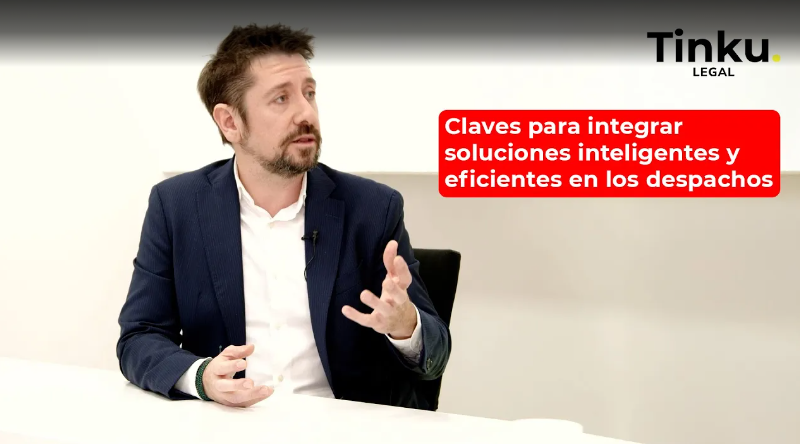
The legal sector is undergoing a quiet but profound transformation. In Tinku Legal’s LEG-028 episode, Lara Novis speaks withJoaquín Cartagena Martínez, CEO ofAbsia Legaltech, about how to integrate smart and efficient technological solutions into law firms. The goal: to reduce administrative tasks, optimize processes, and free up time for what truly matters—the practice of law.
The Silence of Data and Technological Challenges
One of the main obstacles law firms face is what Cartagena calls “the silence of data.” The fragmentation of information—disorganized emails, physical files, scattered folders—limits the possibilities for automation. Without a sound data strategy, implementing artificial intelligence solutions becomes unfeasible.
At Absia Legaltech, they focus specifically on that initial phase of data cleansing and organization. Their approach is rooted in business intelligence and data strategy to help law firms better structure their information. Without this step, any technological solution would be incomplete.
Fear of being replaced: the major organizational challenge
Beyond the technical aspects, Cartagena points to cultural fear as a key barrier. In a traditional field such as the legal profession, many professionals fear that technology could replace certain roles.
“It’s completely uncertain,” says Absia’s CEO. “The software isn’t meant to replace, but to help.”
Overcoming that resistance requires a paradigm shift. It is not a matter of replacing lawyers, but rather of giving them tools that free them from repetitive tasks and allow them to focus on strategy and legal analysis.
Legal Compliance and Ethical Responsibility in AI
The introduction of artificial intelligence into the legal field poses clear challenges: compliance with the GDPR, alignment with the future Artificial Intelligence Act (AI Act), and the handling of sensitive data.
Cartagena emphasizes that regulatory compliance must be addressed from the design stage: “Security by design and responsible infrastructure, from the prompt to model training.” Its consulting firm opts for solutions such as private cloud environments, end-to-end encryption, and the option to run models on-premises, if the client requires it.
The “human-in-the-loop” principle is key: the lawyer must always have ultimate control over the technological tools.
Democratizing AI: Solutions for Independent Lawyers
During the interview, Joaquín Cartagena presented one of the solutions developed by his company, which was showcased at Web Summit Lisbon. It is a SaaS platform designed for independent attorneys and small law firms, which allows users to set up an agent network in just eight minutes without technical assistance.
This solution addresses one of the industry’s main challenges: the hidden costs and learning curve associated with advanced technologies. Thanks to this tool, tasks such as customer service, payment processing, scheduling, and data extraction from the CRM can be automated using a chatbot integrated with WhatsApp Business.
Automating Non-Billed Tasks: Tips for Getting Started
One of the most important points of the conversation was the strategy for taking the first steps. Cartagena sums it up clearly: “We’re going to try not to try to do too much at once.” It’s not about automating everything all at once, but rather starting with tasks that have less legal significance but a high operational impact, such as administrative management.
These “quick wins” generate a rapid and tangible return on investment. Freeing up time allows attorneys to focus on what matters most: analyzing the case and making strategic decisions.
A Roadmap to Digital Transformation
The interview concludes with a clear message: law firms should not fear technology, but rather learn to integrate it gradually and ethically. To do so, it is essential to have partners like Absia Legaltech, who understand both the unique aspects of the legal world and the possibilities offered by innovation.
Cartagena insists that the future of the legal profession lies in efficient tools—controlled by lawyers themselves and designed to expand their capabilities, not to replace them. This transformation is not only possible; it is necessary.