

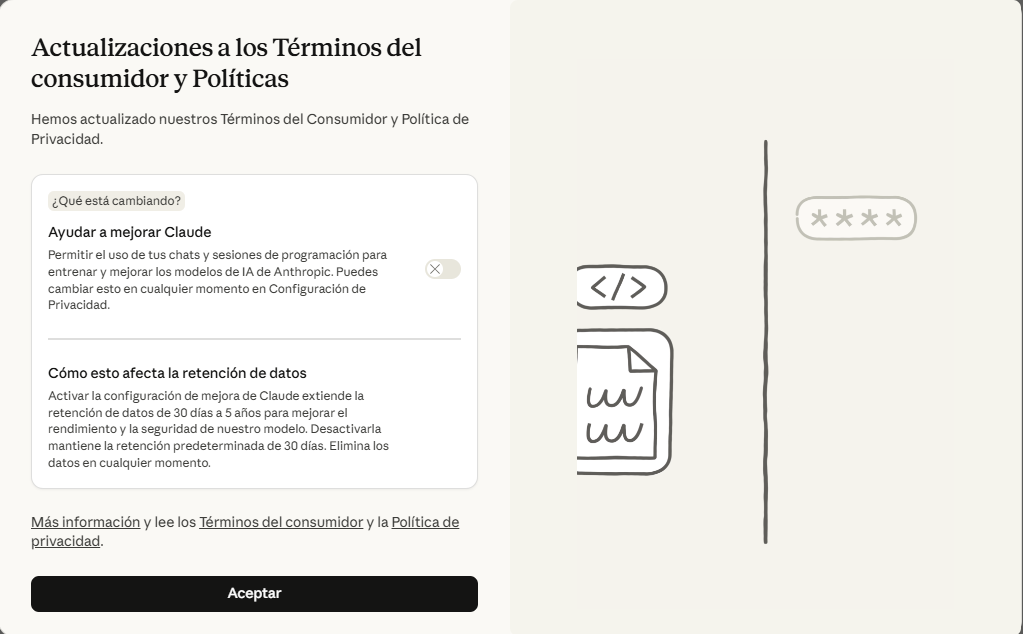
In the age of hyper-personalization, where user experience (UX) reigns supreme, we are crossing very dangerous lines when it comes to privacy. The promise of a perfect digital experience is giving rise to a silent but critical trend: the almost automatic acceptance of the retention of our personal data for excessive periods of time. The risk is significant. One of the fundamental pillars of the General Data Protection Regulation (GDPR) is at stake: the principle of data retention limitation. While the regulation does not establish a minimum retention period (in my personal opinion, a regulatory absurdity typical of framework laws).
As a lawyer specializing in digital rights and the CEO of a tech startup, I feel compelled to address the extensions to data retention periods that large language models (LLMs) are already proposing as a form of consent to extend data retention to up to 5 years. I believe this constitutes a direct and fundamental violation of the principle of non-retention of personal and confidential data established in the European General Data Protection Regulation.
The Danger of Misunderstood Hyper-Personalization
Tech companies and AI developers are normalizing the idea that, in order to provide a more seamless experience, they need to know us better. And how do they do that? By extending the retention of personal data: histories, behavior patterns, interactions, and more. All in the name of an optimized user experience.
But this is not a fair exchange. Most users aren’t even aware that their consent may be being manipulated by “dark patterns.” This, of course, once again highlights—as we’ve warned in other articles and statements—the clash between Europe’s humanistic, secure, and ethical vision of technology and the frenzied pace of technological implementation in other countries, such as the United States and China (the top eight providers of generative AI).
GDPR: The wall (or thin barbed-wire fence) that protects our data
Article 5.1.e ofthe General Data Protection Regulationis clear: data must be retained only for as long as necessary to fulfill the purpose for which it was collected. Extending these retention periods under the pretext of improving the user experience is not only an abuse of consent but also a direct threat to privacy.
This principle is not merely symbolic. It is the legal safeguard that prevents us from being constantly monitored and profiled. Without it, large language models (LLMs), virtual assistants, and recommendation systems could justify retaining everything about us indefinitely.
What does the new AI law in Europe say?
The AI Act, inturn, imposes strict obligations on high-risk systems, such as many of the models that process large volumes of personal data. It requires transparency, traceability, and human oversight.
However, there is still a critical gap when it comes to data retention for training and personalization purposes. This strikes me as an oversight that is not without cause for suspicion. This is where we must be most vigilant.
Conclusion: Consent is not a blank check
Accepting “improvements” to the digital experience should not mean giving up our identity in the long run. Informed consent means understanding, deciding, and being able to reverse our decision. And above all, it means that data that is no longer necessary should not be retained.
Based on my professional experience and work in technology project management, I firmly believe that the user experience must be built on respect, not covert surveillance. The key is to innovate without trampling on rights. And that starts with not sacrificing our privacy for the sake of so-called personalization, which, in reality, strips us of control over our own data.